GNU Radio Conference 2025
Edward D. Hansen Conference Center
GNU Radio Conference (GRCon) is the annual conference for the GNU Radio project and community, and has established itself as one of the premier industry events for Software Radio. It is a week-long conference that includes high-quality technical content and valuable networking opportunities. GRCon is a venue that highlights design, implementation, and theory that has been practically applied in a useful way. GRCon attendees come from a large variety of backgrounds, including industry, academia, government, and hobbyists. Offering an annual program with broad appeal, GRCon attracts a variety of participants: people new to software radio who are interested in learning more, seasoned developers ready to show off their latest work, and experts who want to keep their finger on the pulse and direction of the industry.
GRCon25 is the 15th Annual GNU Radio Conference and will be held September 8-12, 2025 in Everett, Washington.
Key Dates
- March 10 - Call for Participation Opens
- March 15 - Registration Opens
- June 13 - *Extended* Call for Participation Closes
- July 7 - (Initial) Main Track Schedule Posted
- September 8 - Conference Begins
We invite developers and users from across the GNU Radio Community to present your projects, presentations, papers, posters, and problems at GNU Radio Conference 2025.
GRCon25 Schedule Overview
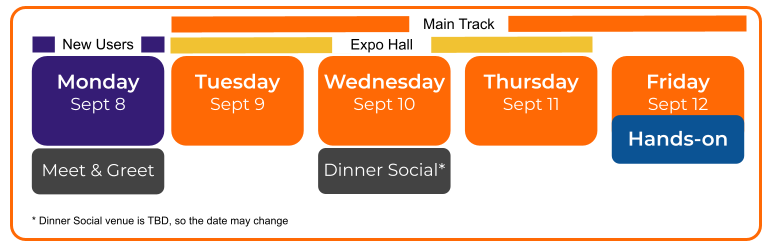
The conference should conclude by 1300 (ish) on Friday. As a final note, slides and your final paper should be submitted by Friday, 5 Sept. Feel free to reach out to the technical chair at [nrogers@gnuradio.org](mailto:nrogers@gnuradio.org) if you have any questions.
Attendance Justification Letter
Do you need help justifying why your manager or supervisor should send you to GRCon this year? Feel free to use this example email.
Zero Retries Digital Conference (ZRDC)
The inaugural Zero Retries Digital Conference (ZRDC) 2025 will be held in Everett, Washington, USA on Saturday, September 13, 2025. Please check out the info here: https://www.zeroretries.org/p/conference
ZRDC 2025 will be held in the same venue as GRCon25 - the Edward D. Hansen Conference Center in downtown Everett.
While GRCon 2025 and ZRDC 2025 are being held consecutively, and at the same venue, the two events are independent of each other.
-
-
09:00
Monday Check-in
-
Other: Conference Setup Ballroom 1
Ballroom 1
Edward D. Hansen Conference Center
-
Workshop: Workshop Room #1 Ballroom 3S
Ballroom 3S
Edward D. Hansen Conference Center
-
1
Workshop comms basics with Mr. Standage-Beier
PLACEHOLDER
Speaker: Wylie Standage-Beier -
2
Practical SDR: Getting Started with Software-Defined Radio
This workshop by author of the eponymous book introduces hobbyists, students, and RF prototyping engineers to practical SDR concepts
Speaker: Mr Paul Clark (Factoria Labs) -
3
Reverse Engineering a Simple RF Remote
Everyone loves a good puzzle -- this workshop challenges participants with a classic signals mystery: how can we decode the transmission from a basic RF remote and spoof it using our own SDR hardware? In this hands-on, fully interactive session, attendees will reverse engineer a simple, commercially available RF remote. We’ll focus on analyzing and characterizing the signal, then recreating it in GNURadio. Participants should have a solid understanding of GNURadio fundamentals and basic SDR operation. A limited number of SDRs may be available for use, but participants are strongly encouraged to bring their own transmit-capable SDR devices.
Speaker: Dr Neil Rogers (USAFA)
-
1
-
Workshop: Workshop Room #2 Conf Room 1
Conf Room 1
Edward D. Hansen Conference Center
-
4
SDRs and Aviation Radio Communications
This workshop presents an overview of well-known aviation radio communications, such as ACARS and ADS-B. The first part presents the usage of these capabilities in an operational context. The second part of the workshop presents SDR tools that can be used to receive these radio communications. The emphasis is on low cost hardware and open source software packages.
Speakers: Mr Alvin Sipe, Dr Paul Comitz
-
4
-
12:00
Lunch
-
Hands-On Activities: GNU Radio Installation Room Ballroom 1
Ballroom 1
Edward D. Hansen Conference Center
Super informal time to come work on GNU Radio related activities. We'll have volunteers here to help get started with GNU Radio installation, maybe even show some other cool tools.
-
15:00
PM Break
-
Social: Meet and Greet Arena Grill
Arena Grill
Edward D. Hansen Conference Center
-
09:00
-
-
08:15
Conference Check-in
-
Keynote: Tuesday Keynote
-
5
Keynote: Prof. Joshua Smith
-
5
-
Project Talk
- 6
-
10:45
AM Break
-
Expo Hall Ballroom 2
Ballroom 2
-
Capture the Flag (CTF) Ballroom 3N
Ballroom 3N
Capture the flag (CTF) is a competition where contestants earn points by finding secret messages ("flags") hidden in radio signals. Challenge yourself and improve your GNU Radio skills!
-
Keynote
-
7
Keynote: Dr. Adam Anderson
Adam L. Anderson received the B.S. and M.S. degrees from Brigham Young University, Utah, USA, in 2002 and 2004, respectively, and the Ph.D. degree from the University of California at San Diego, California, USA, in 2008. Dr. Anderson worked in academia for almost a decade producing 50+ publications including in journals, conferences, and disclosures. He is the inventor of Deepmod, was previously a SETA at the Defense Advanced Research Projects Agency (DARPA) and is currently program manager for the Endless Generative Waveforms (End-Gen) program at the Intelligence Advanced Research Projects Activity (IARPA). Dr. Anderson was the winner of the 2014 DARPA Spectrum Challenge, recipient of the 2014 Leighton E. Sissom Award for Creativity and Innovation, and was awarded as a prize-winning Finalist in the 2019 DARPA Spectrum Collaboration Challenge. Dr. Anderson is married with eight children.
Speaker: Adam Anderson
-
7
-
Workshop: Workshop Room #1 Ballroom 3S
Ballroom 3S
Edward D. Hansen Conference Center
-
8
Quantifying Signal Quality: Practical Tools for High-Fidelity Waveform Analysis
Measuring the quality of high-performance waveforms with sub-dB accuracy is a technically demanding task. Subtle missteps in alignment, scaling, or statistical assumptions can lead to misleading results—even when using familiar tools. This workshop offers a clear and practical path through those challenges, equipping participants with the insight and techniques needed to measure signal quality with confidence and precision.
Drawing from real-world applications in software-defined radio and high-performance data converters, we’ll explore FFT-based spectrum analysis, Welch PSD, Error Vector Magnitude (EVM), and Allan Deviation (ADEV) for analyzing both stationary and non-stationary signals.
The session begins with a guided technical presentation covering these essential waveform analysis methods and how to properly apply them to real world signals. Demonstrations will include techniques for accurately measuring the ENOB (Effective Number of Bits) of high-speed, high dynamic range A/D converters, along with SNR and EVM analysis of 4096-QAM signals. We’ll also show how EVM can be applied at multiple points in a signal processing chain to isolate and identify dominant noise and distortion sources—providing a practical framework for validating each stage of a system.
In the second half, participants will follow live Python demonstrations using Jupyter notebooks and custom-developed tools that automate alignment, normalization, and measurement workflows. These tools are designed for both transparency and teaching value, revealing each analysis step while helping users avoid common pitfalls in post-processing and simulation environments.
Attendees will leave with reusable Python code, complete installation instructions, and the hands-on knowledge to perform precise, repeatable waveform measurements across a wide range of SDR and DSP applications. Whether you’re debugging a signal chain, characterizing a converter, or verifying system performance, this workshop will help you replace ambiguity with rigor—and produce signal metrics you can trust.
Speaker: Dan Boschen
-
8
-
Workshop: Workshop Room #2 Conf Room 1
Conf Room 1
Edward D. Hansen Conference Center
-
9
GNU Radio on Embedded SDRs
Embedded software defined radios require special considerations and a more complete understanding of the hardware and Linux subsystems to maximum the use of the radio. This Workshop will cover special considerations including lower level hardware access including registers, gpio control, debugfs parameter control, and limited memory availability. Other topics including make use of FPGAa and other accelerators will be included. In addition the workshop will also cover the use of the Yocto Project/ObenEmbedded for building a custom Linux distribution for optimal control of your software stack and reasons to use it. The ability to use a shared sstate cache to greatly improve build times for users will be demonstrated. GNU Radio and multiple OOTs will be built into the custom image, with compiler optimizations for the hardware included.
Speakers: Philip Balister, Toby Flynn (Red Wire Technologies, LLC)
-
9
-
Lightning Talk Block
-
12:00
Lunch
-
Main Track
-
10
Sponsor Talk: Two decades of SDR: USRP past, present and future
It is now over twenty years since the first USRPs were shipped to SDR hackers around the globe, and the development of SDRs has not stopped. As proud sponsors of the GNU Radio conference, we therefore use this opportunity to present on current SDR activities at NI and give an update on what SDR power-users can expect in the near future.
Speaker: Martin Braun (GNU Radio) -
11
A GNU Radio Framework for Real-Time Beam Steering with Reconfigurable Intelligent Surfaces
This work presents a practical framework for sustaining robust mmWave communication links in non-line-of-sight (NLoS) scenarios using a dynamically reconfigurable intelligent surface (RIS) operating at 28 GHz. The system integrates GNU Radio with a Python-based control backend to coordinate signal processing, RIS steering, and beam selection in real time. The focus of this work is on the testbed implementation -- specifically, the integration of dynamic RIS control with SDR hardware, synchronization across components, and the communication pipeline between GNU Radio and external control processes. Experimental results under mobile receiver conditions demonstrate the system’s ability to adaptively maintain mmWave links using dynamic RIS hardware and off-the-shelf SDR platforms, with minimal training overhead and high link reliability.
Speaker: Mr Parker Wilmoth (Florida Atlantic University) -
12
Implementation and Analysis of ExpressLRS Under Interference Using GNU Radio
ExpressLRS is an open-source high refresh radio control link that has proven resilient to interference while maintaining a maximum achievable range at that rate with low latency. Designed to be the best FPV Racing link, it is based on the Semtech SX127x/SX1280 LoRa hardware combined with an Espressif or STM32 processor. We build the first known open-source implementation of ExpressLRS in GNU Radio by building upon the existing GNU Radio implementation of LoRa (known as gr-LoRa), to support frequency hopping. We propose to investigate the resilience of ExpressLRS in the presence of different types of RF interference. ExpressLRS is designed to operate in both 900 MHz and 2.4GHz. We will present performance evaluation results from both software-in-the-loop and hardware-in-the-loop tests based on the ADALM PlutoSDRs and COTS platforms that support the ExpressLRS protocol.
Speaker: Mr Gabriel Garcia (Florida Atlantic University) -
13
Wide-Band Antenna Pattern Mapping with an RFSoC on a Drone
We designed and tested a drone with a wide-band transmitter (down to 30 MHz up to to 1.8 GHz) to measure the complex antenna pattern of radio telescopes. We basically split a VNA in half and flew one half on a drone. Radio telescopes at sub GHz frequencies are often not mechanically steerable. They are composed of arrays of dipoles, troughs, or dishes "pointing up". This makes it challenging to know the antenna pattern of each feed when ground and mechanical conditions cannot perfectly be simulated. The far sidelobes are especially challenging to measure, but must be known accurately to measure highly-redshifted hydrogen. Often such telescopes (e.g. CHIME) are used as an interferometer, with a fixed number of channels (e.g. 1024) across their bandwidth (e.g. 400-800 MHz) leading to a fixed FFT repeating time window (e.g. 2.56 µs). Using a Xilinx RFSoC 4x2 board on a drone, we generate a chirp, sampled at 4 GSPS, which spans exactly this bandwidth and repeats at exactly this FFT time window. This allows us to use the existing correlation infrastructure to measure both the magnitude and phase of the antenna response in each spectral bin and in every direction as the drone flies a spiral hemisphere pattern. In the development phase, we measured the beam pattern of a dual-polarized 1-meter parabolic dish. This required us to implement our own 2-input RFSoC receiver in Verilog and python, with flexibility to mimic the bandwidth, number of spectral channels, and repeating time window of many sub 2 GHz radio telescopes that are deployed or planned.
Speaker: Jason Gallicchio (Harvey Mudd College)
-
10
-
Lightning Talk Block
-
15:00
PM Break
-
Main Track
-
14
Building a 23cm SDR Based EME System
EME, often known as Earth-Moon-Earth is a way of communicating between two earth stations by using the Moon as a passive reflector. This presentation will show in detail how to design and build an SDR based radio with low noise amplifiers, power amplifiers and antenna systems to successfully communicate using the Moon as a reflector. Details will be presented on the RF and analog design, initial tests using GnuRadio, signal processing used, and final implementation of the complete system.
Real time Doppler frequency compensation and transmit/receive control will also be presented.Speaker: Dennis Rosenauer -
15
Design and Prototyping of a Multi-Channel Wideband SDR-Based VSG/VSA for Standard-Compliant Signal Testing
As wireless communication standards evolve, techniques such as wideband, multi-channel transmission, and high-order modulation are conducted to support higher data rates and throughput. For example, IEEE 802.11ax employs 1024-QAM with up to 160 MHz bandwidth, while IEEE 802.11be extends support to 4096-QAM and 320 MHz bandwidth. In cellular networks, 3GPP 5G NR supports bandwidths up to 100 MHz in FR1 and 400 MHz in FR2, whereas LTE supports up to 20 MHz per component carrier. However, the specialized test equipment like vector signal generators (VSGs) and vector signal analyzers (VSA) required for these evolving standards often presents a significant cost barrier for academic, R&D, and production facilities.
To address this, we present a wideband software-defined radio (SDR)-based VSG/VSA prototype compliant with 5G NR and 802.11ax standards. The design features core software functions for generating, demodulating, and analyzing waveforms, with key metrics including power spectral density (PSD), error vector magnitude (EVM), carrier frequency offset (CFO), IQ imbalance, and DC offset. The hardware platform is the USRP X410, chosen for its extensive RF range, wide bandwidth capabilities, and native 4-transmit/4-receive channels, which are crucial for parallel testing and improving testing efficiency.
Key integration challenges included implementing a power calibration process to ensure measurement precision and developing dedicated FPGA resources within the RFNoC framework to manage wideband signals across all 4x4 channels. Validation against a Keysight 89600 VSA confirmed the prototype's accuracy, demonstrating an EVM of -40 dB for 5G NR 400 MHz waveforms and -43 dB for 100 MHz in a loopback test. Its real-world applicability was further confirmed through successful over-the-air testing with 5G device under test (DUT).
This work offers academic value through SDR-based signal demodulation and analysis algorithms while providing a practical, scalable, and cost-effective solution for industrial applications. Future extensions, such as AI-assisted measurement, diagnosis, and testing, can further enhance its capabilities.Speaker: Chien-Min Chen (Yuan-Ze Univ. Comm. Research Center, Taiwan) -
16
Bridging ROS2 and GNU Radio for Connected Robotics
Connected robotic systems perform many complex tasks through coordination, such as cooperative search of an environment, consensus, rendezvous, and formation control. At their core, these systems rely on local coordination between intelligent agents making reliable, low-latency, high-rate wireless communication of primary importance. Beyond simply maintaining connectivity, reliable communication may mean supporting heterogeneous and possibly time-varying communication rates amongst different pairs of agents. For example, some agents may need to use the network for transmitting video while others may simply wish to transmit status information. In this paper, we will describe an approach to bridge ROS and GNU Radio to enable the utilization of software-defined radios, such as Universal Software Radio Peripherals (USRPs), within the ROS ecosystem for connected robotics applications. This work is the driver of the NSF-sponsored research testbed at FAU’s Center for Connected Autonomy and AI, which focuses on networked robotics. To achieve robot-to-robot communication we will incorporate GNU Radio-based LoRa transceivers. The integration is achieved through a custom GNU Radio block that interfaces the PHY layer of gr-LoRa with the upper layers of LoRaWAN implemented in python and the data distribution service in ROS. Data is labeled based on ROS topics and transmitted using TCP ports between GNU Radio and ROS. The experimental setup involves two Clearpath Dingo indoor mobile robots, each equipped with an NVIDIA Jetson Orin and a USRP B210. We show that Dingos can share their locally generated LiDAR maps by establishing an ad-hoc wireless communication link. Link signal-to-interference plus noise ratio is optimized by dynamically controlling the relative locations of the two robots.
Speaker: Mr Felipe Sanchez (Florida Atlantic University)
-
14
-
Breakout Session: Women+ @GRCon Meetup Conf Room 1
Conf Room 1
Edward D. Hansen Conference Center
-
08:15
-
-
08:15
Conference Check-in
-
Keynote: Wednesday Keynote
-
17
Keynote: Dr. Thomas Rondeau
Thomas W. Rondeau, Ph.D.
Principal Director for the FutureG Office
Office of the Deputy Chief Technology Officer (Science and Technology),
Under Secretary of Defense for Research and EngineeringDr. Tom Rondeau is the Principal Director for the FutureG Office for the US Department of
Defense, serving in the Office of the Undersecretary of Defense for Research and Engineering (OUSD(R&E)). In this role, Dr. Rondeau is responsible for the research, funding, and execution of programs to advance warfighting capabilities using future-generation wireless technologies.Before assuming his role as Principal Director of the FutureG Office, Dr. Rondeau spent more than six years as a Defense Advanced Research Project Agency (DARPA) program manager, where he led efforts that challenged and advanced studies in a variety of warfighting domains, earning him the Distinguished Public Service Medal. Prior to joining DARPA, Dr. Rondeau led the GNU Radio project, consulted on wireless communications problem sets, and worked as a visiting researcher with the University of Pennsylvania and as an Adjunct with the IDA Center for Communications Research in Princeton, NJ.
Dr. Rondeau holds a Ph.D. in electrical engineering from Virginia Tech, where his dissertation won the Council of Graduate Schools’ 2007 Outstanding Dissertation Award in math, science, and engineering
-
17
-
Main Track
-
18
Shaking Up 5G: Phase Noise vs EVM in OFDM Systems
How does oscillator phase noise degrade Error Vector Magnitude (EVM) in 5G NR waveforms? This talk presents a step-by-step methodology to predict that impact—starting from a modeled phase noise spectrum and ending with EVM performance metrics for a 5G NR OFDM signal.
We show how to calculate the expected EVM from vibration-induced phase noise using known system parameters, and validate these predictions through full waveform simulations at 6.05 GHz. The approach links oscillator g-sensitivity, vibration profiles, and spectral characteristics to real impairments in constellation quality.
Attendees will gain a practical framework for anticipating and evaluating phase noise effects in 5G systems and SDR-based test environments.
Speakers: Dan Boschen (Microchip), David Chandler
-
18
-
Workshop: Workshop Room #1 Ballroom 3S
Ballroom 3S
Edward D. Hansen Conference Center
-
19
You can do everything with MultiUSRP, and for everything else there is RFNoC
This session offers a comprehensive tutorial on using the MultiUSRP API and RFNoC API of the USRP Hardware Driver (UHD) driver to leverage USRP devices for real-time RF data streaming. Attendees will be introduced to UHD, exploring its core architecture and the functionalities of the MultiUSRP and RFNoC APIs. The tutorial includes practical examples, options to counter streaming errors, and provides suggestions to optimize data streaming rates between host and USRP devices. The MultiUSRP API, compatible with all USRP devices from B200 to X440, utilizes standard FPGA images for seamless deployment, and can be accessed via C++, Python, GNU Radio, and LabVIEW. Participants will gain a practical understanding of the MultiUSRP API and learn when to employ the more advanced RFNoC API for specific use cases.
Speakers: Jonathan Pendlum, Marian Koop (NI), Michael Dickens, Mr Neel Pandeya (National Instruments) -
20
GPU Accelerated Block Development
In this workshop, we will learn how to effectively integrate CUDA into GNU Radio blocks. There will be a brief tutorial of CUDA kernels and the CUDA Core Compute Libraries (CCCL). We will create a few GPU accelerated GNU Radio blocks and work through strategies for testing, debugging, and optimizing these blocks.
Speaker: John Sallay (BCubed Engineering)
-
19
-
Workshop: Workshop Room #2 Conf Room 1
Conf Room 1
Edward D. Hansen Conference Center
-
21
GR4 Tutorial - Creating new blocks
https://github.com/mormj/gr4-block-tutorial
In this workshop we will work through the details of creating new blocks in GR4. The focus will be how to implement the GR4 equivalents of the work function, and how to integrate blocks into running flowgraphs, demonstrating the benefits of GR4.
Speaker: Josh Morman -
22
Simple Replay Attack Demo with GNU Radio
This workshop showcases replay attacks on a mini-setup which includes remote-controlled LED and an off-the-shelf SDR. Workshop aims to show how GNU Radio can be used in every step of a replay attack attempt.
In the workshop, we will be using a simple RF radio device, a remote control, and a transmit-capable SDR in order to receive and transmit signals. The remote is used to turn on and off the lights. It has A, B, and OnOff keys on it. We will first search the signal from the original transmitter, capture it, and save it to replay later. In the first part of the workshop, we will use SDR along with GNU Radio to do replay attack with a captured radio signal. In the second part, SDR native tools will be utilized to do the same. In the last part, RF data from the remote control will be analyzed and decoded with the help of Inspectrum application, and GNU Radio will be used to synthesize the signal.
Speaker: Murat Sever (TOBB ETU)
-
21
-
10:45
AM Break
-
Expo Hall Ballroom 2
Ballroom 2
-
Capture the Flag (CTF) Ballroom 3N
Ballroom 3N
Capture the flag (CTF) is a competition where contestants earn points by finding secret messages ("flags") hidden in radio signals. Challenge yourself and improve your GNU Radio skills!
-
Main Track
-
23
Over-the-Air Sequential Uplink Data Processing in Small-Scale Cell-Free mMIMO Networks
A widely studied configuration within Cell-Free massive Multiple-Input Multiple-Output (CF mMIMO) networks is the centralized architecture, where all Access Points (APs) are connected to a Central Processing Unit (CPU) that performs Linear Minimum Mean Square Error (LMMSE)-based uplink signal estimation. As an alternative, sequential uplink signal processing refines users' signal estimates incrementally through a daisy-chain of APs. While theoretical analysis predicts equal performance as centralized processing, the effect of real-world constraints on this equivalency has not yet been evaluated.
This thesis presents an over-the-air implementation of sequential uplink processing for CF mMIMO systems using GNU Radio and PlutoSDRs. A small-scale prototype with two users and two APs is developed to evaluate sequential signal estimation. Unlike many studies in the literature, the evaluation accounts for real-world signal propagation and processing constraints. Those include propagation through a wireless channel and impairments introduced by the radio transceiver, as well as limited precision in digital signal processing, imperfect synchronization, and measured channel statistics. As a foundation, a state-of-the-art Orthogonal Frequency Division Multiplexing (OFDM) transmitter in GNU Radio is extended for flexible multi-user operation. A custom-designed receiver is introduced, incorporating support for LMMSE-based signal and channel estimation, multi-user and multi-AP configurations and coarse time synchronization via a Zadoff-Chu sequence preamble.
To enable LMMSE channel and signal estimation, a method to derive real-world channel statistics through experimental measurements is proposed and applied. The results reveal key deviations from idealized assumptions with most notably channel statistics that vary across measurements, likely caused by fine time synchronization errors in the PlutoSDRs. Nonetheless, since the channel variance consistently exceeds the noise variance, the estimation method remains robust to these variations.
Experimental results confirm that the implemented sequential and centralized architectures produce nearly identical uplink signal estimates when applied to the same dataset, with discrepancies on the order of 10-3 likely due to limited numerical precision in Python.
Speaker: Catherine Mertens -
24
Hardware-in-the-Loop Simulation with PYNQ for Radar Applications
This work presents a novel hardware-in-the-loop (HIL) simulation framework for testing and evaluation of digital signal processing routines for active radar systems by leveraging the open-source PYNQ (Python Productivity for Adaptive Computing Platforms) framework. This test and evaluation approach offers several advantages, including increased accessibility, reduced development time, and faster iteration speed for field programmable gate array (FPGA)-based hardware acceleration. In our work, we demonstrate various methods for generating realistic radar scenarios incorporating several emitter types and propagation environments. By co-simulating parts of the radar receiver chain in hardware and software, our work aims to quickly validate algorithms, optimize system performance, and accelerate the development cycle for novel radar applications with a focus on iterative development. This HIL approach is validated against an active radar scenario with various emitters and paves the way for an adaptable research and development workflow for novel radar applications using commodity hardware, open-source software, and emerging programming paradigms using FPGAs.
Speaker: Christopher Long (Naval Information Warfare Center Atlantic) -
25
gr-PHYSEC: Real-time Channel-based Key Generation for Physical Layer Secure Wireless Communications
Securing wireless communication against eavesdropping is critical, particularly in dynamic and decentralized environments. We present gr-PHYSEC, a new GNU Radio out-of-tree (OOT) module for real-time physical-layer key generation. Unlike traditional key generation that relies on pre-shared secrets or computational complexity, our approach derives symmetric keys from the wireless channel’s inherent randomness.
We embed a trained neural network within GNU Radio to extract channel features between trusted parties (Alice and Bob) during probe exchanges. These features are quantized into binary keys, reconciled via Reed-Solomon encoding, and further secured with SHA-256 hashing. The generated keys are then directly used to encrypt data. Real-world experiments at the FAU CAAI connected robotics testbed using ADALM Pluto software-defined radios and NVIDIA Jetson Orin validate the approach with ground robotic platforms. Results demonstrate low key disagreement rates and strong randomness, as verified by the NIST test suite for random and pseudorandom number generators for cryptographic applications. This integration showcases how GNU Radio can support real-time AI-driven security solutions, pushing the boundaries of software-defined secure communication.
Speaker: Mr Jose Sanchez (Florida Atlantic University)
-
23
-
12:00
Lunch
-
Main Track
-
26
Software–Defined Ground Penetrating Radar Using COTS SDRs and GNU Radio Companion
This project investigates the use of Software Defined Radio (SDR) for Ground Penetrating Radar (GPR) to detect shallowly buried objects, and evaluates its performance against a commercial off-the-shelf (COTS) GPR system. It marks the first engineering collaboration between Weber State University and the 309th Software Engineering Group (SWEG) at Hill Air Force Base (HAFB).
Traditional GPR systems typically employ separate transmitting and receiving antennas on handheld devices or vehicle-mounted platforms. Recent research has shown that small rotor-based unmanned aerial vehicles (UAVs) paired with inexpensive sensors can reduce cost, effort, and time in GPR surveys. However, achieving high resolution typically requires bulky, expensive, and power-intensive systems that are unsuitable for UAV payloads. SDR presents a promising alternative by offering compact, low-cost, and reconfigurable radar capabilities.
The primary objective of this project is to assess the viability of an SDR-based GPR (SD-GPR) as a potential replacement for conventional systems in detecting shallowly buried targets. The SD-GPR is implemented using GNU Radio Companion (GRC) for real-time signal processing, programmed as a Stepped Frequency Continuous Wave (SFCW) radar. Measurements are collected in a controlled test environment with known buried targets, while simulations and post-processing in Python are used to generate and analyze GPR B-scans.
Speaker: Gavin Messerly (Weber State University) -
27
gr:harmonia: A GNU Radio-Based Tool for Synchronization of Software-Defined Radios in a Distributed Radar Network
Precise synchronization of time, frequency, and phase is crucial for coherent processing in distributed radar systems, especially at higher frequencies where timing errors rapidly degrade performance. To enable distributed radar operations such as coherent transmit beamforming, distributed radar systems must achieve time synchronization on the order of tens of picoseconds, requiring extraordinarily robust techniques for correcting timing errors. The gr-harmonia out-of-tree module implements a synchronization algorithm to achieve time, frequency, and phase alignment across distributed radar networks using UHD-compatible software-defined radio (SDR) systems. The algorithm enables decentralized synchronization realized entirely in signal processing and thus requires no additional hardware, allowing it to be implemented in networks of unmodified SDRs. Because the synchronization approach is decentralized, it scales efficiently with an arbitrary number of nodes to be synchronized. The module operates exclusively through the GNU Radio message passing interface, converting pulsed data into a protocol data unit (PDU) to reduce buffering-induced latency. The module utilizes UHD burst mode with metadata flags to schedule pulses with accurate timing. It comprises blocks for waveform generation, transmission and reception of waveforms, frequency and time peak estimation, clock drift estimation, clock bias, and phase estimation. In this paper, the framework and functionality of each block are discussed, and the results of the synchronization process are shown for data collected from an open-air test with three Ettus X310s using gr-harmonia.
Speaker: Mr Cody Kieu (Advanced Radar Research Center, University of Oklahoma) -
28
A study on Developing a Pre and Postamble for OFDM
OFDM transmit and receive blocks have long been available to users, developers, and researchers within the GNU Radio ecosystem [1]. These tools are actively maintained by the community, including many domain experts. In previous work, I collaborated with Mr. Barry Duggan to develop an out-of-tree (OOT) block that implements preamble and postamble support for BFSK modulation. This feature significantly improved synchronization between transmitter and receiver—particularly in acoustic communication systems—yielding exponential gains in performance.
My current research focuses on modulating data through dense materials such as steel rail, where traditional BFSK schemes suffer from severe multipath-induced corruption. OFDM, by contrast, offers a highly suitable alternative due to its inherent resilience to multipath fading [2].
One specific challenge that was resolved using the modified OOT flowgraph was the error-free transmission of JPEG images over BFSK-modulated acoustic links. Header packets and Huffman table bits, which are typically sent first in such links, were often lost, or corrupted before synchronization could occur. This led to image decoding failures, where even a single-bit error rendered the file unreadable. [3]
This study investigates the development of preamble/postamble techniques tailored for OFDM, enabling robust synchronization and reliable data transmission. These advances support the broader research objective of achieving dependable acoustic communication in complex and multipath-dominated media.[4] These techniques are crucial for enhancing data integrity and transmission efficiency in environments where multipath effects can severely impact communication reliability, as evidenced by previous findings in the field [5].
To further enhance the reliability of acoustic communication systems in challenging environments, it is essential to explore adaptive techniques that respond dynamically to varying multipath conditions. For instance, the implementation of real-time channel estimation methods, as evidenced by recent studies, can significantly improve the performance of OFDM by adjusting parameters such as subcarrier spacing and modulation depth based on the instantaneous state of the communication channel [6]. Additionally, integrating diversity techniques, such as spatial or frequency diversity, can mitigate the effects of deep fades that often accompany multipath propagation, thereby ensuring more consistent data integrity during transmission [7]. By leveraging these advanced strategies alongside the preamble/postamble enhancements, we can move closer to achieving robust and efficient data transmission in increasingly complex acoustic environments. Future work will focus on implementing these adaptive techniques in real-world scenarios to validate their effectiveness in maintaining high data rates and low bit error rates under varying conditions..References
[1] M. M. Boter, “Design and implementation of an OFDM-based communication system for the GNU Radio platform,” 2011.
[2] A. Scaglione, S. Barbarossa, and G. B. Giannakis, “Robust OFDM transmissions over frequency-selective channels with multiplicative time-selective effects,” in International Conference on Acoustics, Speech, and Signal Processing, Jun. 2000. doi: 10.1109/ICASSP.2000.861032.
[3] B. A. Banister, B. J. Belzer, and T. R. Fischer, “Robust image transmission using JPEG2000 and turbo-codes,” in International Conference on Image Processing, Sep. 2000. doi: 10.1109/ICIP.2000.900973.
[4] S. Liu, F. Yang, J. Song, F. Ren, and J. Li, “OFDM preamble design for synchronization under narrowband interference,” in International Symposium on Power Line Communications and Its Applications, Mar. 2013. doi: 10.1109/ISPLC.2013.6525859.
[5] “Reliability of Multipath Networks with Optimization of the Location of Inter-Path Communication Nodes,” Mar. 2023. doi: 10.1109/smartindustrycon57312.2023.10110818.
[6] A. C, S. Sundaresan, T. Zacharia, R. Gandhiraj, and K. P. Soman, “An Experimental Study on Channel Estimation and Synchronization to Reduce Error Rate in OFDM Using GNU Radio,” Procedia Computer Science, Jan. 2015, doi: 10.1016/J.PROCS.2015.01.017.
[7] M. A. (Corresponding Author), R. Braun, and Z. Chaczko, “Multipath in Complex Acoustic Channels with an OFDM Solution”.
Speaker: Mr Michael Alldritt -
29
Real-time WiFi Device Fingerprinting and Re-identification in GNUradio
WiFi device fingerprinting and re-identification (RFFI) are critical functions for wireless security, mobility intelligence, and many other applications. However, rapid prototyping and evaluation of fingerprint extractors remains a challenging task. Model performance evaluation requires exploring various environmental conditions, emitter types, and more.
To streamline this process, we introduce gr-rffi — a GNUradio block for real-time evaluation of device fingerprinting and re-identification models. The block is designed to ingest, transform, and perform real-time inference on IQ samples from OFDM preambles, producing and storing device embeddings in a connected vector database. The output of the block is a stream of pairs of synthetic device IDs and vector embeddings for further analysis.
We demonstrate gr-rffi by performing real-time fingerprinting and re-identification of a set of controlled WiFi emitters with randomized MAC addresses. The flowgraph implements ingestion of IQ samples from a Pluto+ SDR signal source, decodes OFDM frames using gr-ieee802-11 suite, performs device fingerprinting and re-identification using gr-rffi, and combines synthetic device identifiers with recognized frame signatures on a real-time flowchart rendered by the TorchSig gr-spectrumdetect block.
Speaker: Stepan Mazokha (Florida Atlantic University)
-
26
-
Lightning Talk Block
-
15:00
PM Break
-
Main Track
-
30
Sponsor Talk: Aaronia
-
31
Fast FFTs on ARM using RustFFT
GNU Radio uses FFTW for it FFT computations. In many cases, FFTW has excellent performance. However, newer libraries are emerging that in some important cases have better performance. Additionally, the Rust language is becoming more popular due to its built in safety guarantees.
When porting some FFT intensive GNU Radio blocks to an ARM based system, significant performance degradation were observed. It was found that the RustFFT library performed significantly better. This talk will show how c++ wrappers for the rust library were created and compare the performance of FFTW on RustFFT on the ARMv8 based Jetson Orin platform.
Speaker: John Sallay (BCubed Engineering) -
32
Phase Coherency - Translating Phase and Time Accuracy to the Real World
Multi-Channel RF Systems using wide bandwidth signals are common in many applications. Keeping all channels - even distributed ones - well synchronized is a common ask from these types of systems. In reality, RF and baseband synchronization are not perfect though - but how accurate do they need to be for a given application?
Is 1 ps plenty? Is it not enough? Will 10 degree phase offset work fine? Do I need to be any more accurate when using more than a handful of channels? Are there any practical numbers that are guiding us?
Let's find out.Speaker: Jan Schirok (Emerson)
-
30
-
Social: Wednesday Social
-
33
USRP 20th Birthday Celebration Carleton Farm
Carleton Farm
630 Sunnyside Blvd SE, Lake Stevens, WA 98258Dinner + Drinks + Games + Prizes
Gather in the front lobby or front of venue 5:30-5:45 PM to arrange ride sharing
-
33
-
08:15
-
-
08:15
Conference Check-in
-
Keynote: Thursday Keynote
-
34
Keynote: Bradley M. Kuhn
Bradley M. Kuhn is the Policy Fellow and Hacker-in-Residence at Software Freedom Conservancy (SFC). Kuhn began his work in the software freedom movement as a volunteer in 1992, as an early adopter of Linux-based systems and contributor to various FOSS projects, including Perl. He worked during the 1990s as a system administrator and software developer for various companies, and taught AP Computer Science at Walnut Hills High School in Cincinnati. Kuhn’s non-profit career began in 2000, when he was hired by the Free Software Foundation (FSF). As FSF’s Executive Director from 2001–2005, Kuhn led FSF’s GPL enforcement, launched its Associate Member program, and invented the Affero GPL. Kuhn began as SFC’s primary volunteer from 2006–2010, and became its first staff person in 2011. Kuhn's work at SFC focuses on enforcement of the GPL agreements, FOSS licensing policy, and non-profit infrastructural solutions for FOSS. Kuhn holds a summa cum laude B.S. in Computer Science from from Loyola University in Maryland, and an M.S. in Computer Science from the University of Cincinnati. Kuhn’s Master’s thesis discussed methods for dynamic interoperability of Free Software programming languages. Kuhn received the Open Source Award in 2012, and the Award for the Advancement of Free Software in 2021 — both in recognition for his lifelong policy work on copyleft licensing and its enforcement.
-
34
-
Project Talk
- 35
-
10:45
AM Break
-
Expo Hall Ballroom 2
Ballroom 2
-
Capture the Flag (CTF) Ballroom 3N
Ballroom 3N
Capture the flag (CTF) is a competition where contestants earn points by finding secret messages ("flags") hidden in radio signals. Challenge yourself and improve your GNU Radio skills!
-
Panel Session
-
36
Fireside Chat
Discussions on the history of GNU Radio.
Speaker: Matt Ettus
-
36
-
Workshop Conf Room 1
Conf Room 1
Edward D. Hansen Conference Center
-
37
Amateur Radio License Exams
-
37
-
Workshop Ballroom 3S
Ballroom 3S
Edward D. Hansen Conference Center
-
38
USRP FPGA Processing Using the RFNoC Framework
This workshop provides a tutorial on the RFNoC framework, including a discussion on its design and capabilities, demonstrations of several practical examples, and a walk-through of implementing a user-defined RFNoC Block and integrating it into both UHD and GNU Radio. The RFNoC (RF Network-on-Chip) framework is the FPGA architecture used in USRP devices, specifically the E310, E312, E320, X300, X310, N300, N310, N320, N321, X410, X440. The RFNoC framework enables users to program the USRP FPGA, and facilitates the integration of custom FPGA-based algorithms into the signal processing chain of the USRP radio. Users can create modular, FPGA-accelerated SDR applications by chaining multiple RFNoC Blocks together and integrating them into both C++ and Python programs using the UHD API, and into GNU Radio flowgraphs. Attendees should gain a practical understanding of how to use the RFNoC framework to implement custom FPGA processing on the USRP radio platform.
Speakers: Jonathan Pendlum, Mr Neel Pandeya (National Instruments)
-
38
-
Breakout Session: Women+ @GRCon Social Organizer Space
Organizer Space
Edward D. Hansen Conference Center
-
12:00
Lunch
-
Project Talk: SigMF
-
39
RF Recordings using SigMF
Quick intro to the SigMF standard for storing RF + metadata to file and a brief overview of activity over the last year
Speaker: Marc Lichtman
-
39
-
Main Track
-
40
FPGA Acceleration in GNU Radio: A Block-Centric Approach
Previous attempts to integrate FPGA acceleration into GNU Radio have primarily focused on front-end processing. This abstract proposes a novel approach: extending FPGA acceleration to a block-centric model using non-SDR PCIe FPGAs, with an emphasis on SWAP-C (Size, Weight, Power, and Cost). The goal of this talk is to demonstrate a proof-of-concept for an FPGA-accelerated GNU Radio block.
This work originated from a semester-long master's project utilizing a NiteFury II M.2 Commercial Off-the-Shelf (COTS) FPGA. In this proof-of-concept, data is transferred from the host computer to the FPGA at x4 Gen2 PCIe speeds, processed through a 2:1 decimation filter, and then sent back to the host. This workflow demonstrates the feasibility of using low-cost FPGAs to accelerate processing anywhere within a GNU Radio flowgraph.
While integration with GNU Radio is ongoing at the time of submission, a solution will be presented at the talk. This work serves as a foundational discussion on the future of FPGA acceleration in GNU Radio, providing a framework adaptable from low-cost boards like the NiteFury II to high-end Versal FPGAs, though further design and exploration are needed for managing and deploying GNU Radio FPGA blocks.
Speaker: Troy Bates -
41
Powering Cognitive Radios with LLMs
Large Language Models (LLMs), built on transformer-based deep learning architectures, are increasingly being explored as high-level controllers. With standards like the Model Context Protocol (MCP), LLMs can now orchestrate and interface with external software, including radio stacks such as GNU Radio. Our initial investigation focused on using LLMs to dynamically manage signal processing chains in GNU Radio, with the goal of creating intelligent and adaptable communication systems.
Through this process, we observed that while LLMs are powerful for orchestration, they are sample-inefficient and ill-suited for low-level interactions or deployment on edge devices. This motivated a shift toward alternative learning approaches and led to the development of a new model.
In this paper, we introduce Hebbian Cellular Automata (HCA), a novel learning framework that leverages modulation signals themselves as learning signals. Inspired by principles from neuroscience and communication theory, HCA adapts locally using signal-driven rules rather than backpropagation. This enables decentralized adaptation, emergent behavior, and the construction of fully recurrent neural networks that remain stable and efficient. The approach is well-suited to parallel architectures and integrates naturally into real-time signal processing environments such as GNU Radio.
We present experimental results demonstrating the learning behavior of HCA in signal processing contexts, and discuss its role as a complementary mechanism alongside deep learning-based orchestration in future wireless architectures.
Speaker: Paul David (SimpliRF, LLC.) -
42
Sponsor Talk: AnySignalSpeaker: John Malsbury
-
40
-
Lightning Talk Block
-
15:00
PM Break
-
Main Track
-
43
Streaming, Fast and Slow
One of the hardest problems of high-bandwidth software-defined radio systems is also one of the most basic: Data movement. In this talk, we shall explore some low-level methods of streaming data over Ethernet, including raw sockets, RDMA, and io_uring. We will discuss how we can best use these technologies in GNU Radio and SDR systems, as well as provide some benchmark results on throughput, reliability, and CPU usage. For sake of compatibility with SDR hardware, we shall focus on UDP-based transmission schemes.
All code used to generate benchmarks and test shall be made open-source before the talk on my github page, but the test suite is as of yet incomplete.
Speaker: Martin Braun (GNU Radio) -
44
Real-Time Scheduling and Batching in GNU Radio for Bounded Response Times
This paper and talk investigate the application of real-time scheduling techniques and analysis to the GNU Radio scheduler. Real-time scheduling theory allows for analytical bounds to be derived for end-to-end signal-processing response times. However, the current scheduling infrastructure in GNU Radio is designed using heuristics aimed at improving observed or average performance, not analytical worst-case performance. We therefore apply small changes to the GNU Radio scheduling infrastructure and harness the Linux SCHED_DEADLINE real-time earliest-deadline-first scheduling algorithm to enable more predictable and analyzable real-time signal-processing performance.
Much work on real-time analysis assumes jobs with a fixed length, or worst-case execution time. But invocations of a GNU Radio block could process a dynamic number of samples, depending upon the queue size. We call this “intra-block batching,” and enable fixed-size batches, instead of variable-sized ones. We then can apply real-time scheduling theory to set parameters (execution time and deadline) for the Linux SCHED_DEADLINE scheduler. This allows for existing literature on real-time scheduling to applied more directly to GNU Radio. Furthermore, the scheduling algorithm implemented by SCHED_DEADLINE is optimal for some classes of soft real-time workloads, enabling high analytical platform utilization. We also have experimental results that show that larger batch sizes amortize overheads (e.g., compulsory cache misses, context switch overhead, etc.) over more samples.
These overheads can also be avoided by more carefully considering the interleaving of blocks. For example, if consecutive blocks in the flowgraph are executed sequentially on a common core, they may have cache affinity for outputs and subsequent inputs. If the two blocks could be merged into a single “super block”, a context switch can be avoided. We call this “inter-block batching.” We have developed optimization techniques based upon mixed integer linear programming to compute “super blocks” and minimize overheads through more efficient inter-block batching.
In our paper and talk, we will describe means of reducing overheads by exploiting both inter- and intra-block batching. We will also describe minor changes we made to GNU Radio to enable real-time scheduling analysis results to be put to work to take advantage of the Linux real-time scheduler SCHED_DEADLINE.Speaker: Tiancheng He (Vanderbilt University)
-
43
-
08:15
-
-
08:15
Conference Check-in
-
Keynote: Friday Keynote
-
45
Keynote: Jesse Alexander
-
45
-
Main Track
-
46
Untangling the Airwaves: Implementing and Evaluating Blind Source Separation Techniques in GNU Radio
This talk introduces a GNU Radio Out-of-Tree (OOT) module that implements several blind source separation (BSS) algorithms, including Independent Component Analysis (ICA), Principal Component Analysis (PCA), Non-negative Matrix Factorization (NMF), and Adaptive Event Processing. The module integrates with GNU Radio’s flowgraph architecture, facilitating real-time signal processing within software-defined radio (SDR) applications.
We evaluate the effectiveness of these BSS techniques using both simulated datasets and real-world signals captured via SDR hardware. The primary metric for assessing separation quality is the Signal-to-Interference Ratio (SIR). Additionally, we compare the computational performance of the module across different platforms, analyzing runtimes on both CPU and GPU implementations.
The results highlight the varying performance of each BSS method depending on the nature of the input data and computational resources. Notably, GPU acceleration offers significant reductions in processing time, enhancing the feasibility of real-time BSS in complex signal environments. This OOT module extends GNU Radio’s capabilities, providing researchers and practitioners with a versatile tool for advanced signal separation tasks in SDR systems.
Speaker: Garrett Vanhoy (Peraton Labs)
-
46
-
10:15
AM Break
-
Main Track
-
47
Reception of GOES-East Satellite Services: HRIT and GRB
Software Defined Radio (SDR) has played a transformative role in democratizing access to radio-based systems by reducing the reliance on proprietary hardware and software. In this work, we present two practical implementations of SDR systems for acquiring imagery and data from GOES satellites, highlighting its relevance to both educational contexts and institutional applications.
First, we share lessons learned from implementing a High Rate Information Transmission (HRIT) reception system based on a repurposed Wi-Fi antenna and the SatDump software. Its relative simplicity, requiring neither large parabolic antennas, complex feed designs nor high-end SDR hardware, makes it an ideal entry point for educational or budget-limited applications. We detail which were the critical steps, particularly with respect to modifications to the antenna system, in order to obtain an operational setup which we successfully validated through stable reception and decoding.
Second, we discuss the implementation of a GOES Rebroadcast (GRB) system which, given its higher bandwidth and dual-polarization, requires greater technical complexity and effort. Receiving this service is particularly relevant for institutions such as the Uruguayan Meteorological Institute (INUMET) which, due to limited resources to install and operate a ground station (both technical and economical), currently relies on the Internet to access GOES data. Our system could provide INUMET with the means to achieve sovereignty over satellite meteorological and environmental data, reducing dependence on Internet-based sources, and we share key lessons learned from this deployment. In particular, we employed a decommissioned 3.9 meter parabolic dish and a self-fabricated Septum feed. These, together with the same LNA used in the HRIT setup, a USRP B200 mini SDR and SatDump, enabled reliable reception of GRB signals, demonstrating its viability as an alternative method for accessing this high-resolution imagery and environmental data. The resulting system offers a straightforward, autonomous, and cost-effective alternative to conventional solutions, which often require expensive and highly specialized equipment.
Together, these two case studies illustrate the versatility of SDR in satellite data reception and its potential to empower both individuals and institutions with greater autonomy in accessing critical Earth observation information.
Speakers: Mr Martín Cabrera (Faculty of Engineering - Universidad de la República (Uruguay)), Mr Pedro Pertusso (Faculty of Engineering - Universidad de la República (Uruguay)) -
48
RadioSonic: A Preview of a Teaching Platform Using Audio-Frequency Waveforms
RadioSonic is a new educational platform under development that uses real-time audio propagation to emulate wireless channel behavior for hands-on SDR instruction. By shifting RF waveform experimentation into the acoustic domain, the RadioSonic platform enables exploration of realistic multipath, Doppler, digital modulation, and other physical-layer effects using affordable purpose-built hardware, at a fraction of the cost of equivalent RF hardware when scaled to the speed of light.
This talk provides a first look at the platform’s architecture, anticipated compatibility with GNU Radio, and draft curriculum materials. The underlying concept of scaling the speed of light to the speed of sound on low-cost devices for real-time RF emulation is patent pending and being developed to support SDR and DSP education in environments where cost, licensing, and RF complexity present barriers to learning.
The presentation will illustrate how the platform can be used for hands-on implementation of digital filtering, timing and carrier recovery, and modern modulations such as QAM and OFDM, as well as spatial techniques including diversity, beam steering and MIMO, using wavelength-consistent waveforms that reflect real-world channel effects at audio scale in real-time hardware.
Targeted for release in Spring 2026, the RadioSonic platform will include extensible software released under a permissive license and designed around common interfaces to simplify integration and modification. These design choices are intended to encourage collaboration and future community-developed functionality as the platform matures. Attendees will preview the platform’s direction and have an opportunity to provide feedback to help shape its relevance to the signal processing and GNU Radio communities.
Speaker: Dan Boschen - 49
-
50
TorchSig: ML Training for Custom Datasets
TorchSig is software for radio frequency (RF) machine learning (ML) that generates signals and performs model training for signal detection and modulation recognition. The software is also packaged with the gr-spectrumdetect GNU Radio block which runs an ML model for detection and modulation recognition. The talk and paper discuss the latest advancements in the software: the ability to train against custom, user-provided datasets and a new set of RF-based transforms.
TorchSig has a library of 57 signal types, including frequency shift keying (FSK), quadrature amplitude modulation (QAM), orthogonal frequency division multiplexing (OFDM) and others. Custom signals allow a user the ability to supplement these built-in signals for ML training. The signals can be added in natively within the software or through reading in binary IQ files.
In order to make the signals and environment more realistic, TorchSig implements RF-based transforms which are real-world effects from hardware impairments and channel impairments such as IQ imbalance and quantization. TorchSig also implements ML-based transforms such as time-reversal and IQ swap. The transforms are applied to the signals which are then used to train an ML model against more realistic scenarios. A new, expanded set of transforms is presented.
Custom signals and datasets allow users the ability to integrate specific signals of interest into the automated training pipeline. This capability expands the scope of TorchSig and enables use of the software with any type of signal a user can create or imagine.
TorchSig is free, open-source software available at github.com/torchdsp/torchsig. For more information please see torchsig.com.
Speaker: Matt Carrick
-
47
-
Project Talk: GRCon Main Track Closing
-
12:10
Lunch
-
Breakout Session
-
51
SDR and Amateur Radio Conf Room 1
Conf Room 1
Developments in Amateur Radio and SDR including LinHT, LoRa, and KA9Q-Radio.
Speaker: Steve Stroh
-
51
-
Hands-On Activities Ballroom 1
Ballroom 1
Super informal time to come work on GNU Radio related activities. We'll have volunteers here to help get started with GNU Radio installation, maybe even show some other cool tools.
-
Breakout Session: GRCon Planning and Feedback Ballroom 3N
Ballroom 3N
Convener: Samantha Palazzolo -
Breakout Session: CTF Walkthrough Ballroom 3S
Ballroom 3S
-
52
Capture the Flag Walk-Through
Capture the Flag players will demonstrate how they decoded mystery signals. All are welcome.
-
52
-
08:15